Why do I say this? The answer
is simple.
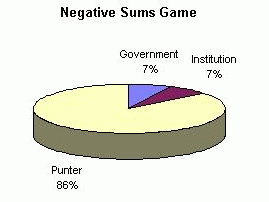
Most forms of gambling
represent a negative
sums game.This means you are competing
for slices of a pie that has already had a chunk bitten
out of it by government, gaming institution or bookmaker.
 For
example, when you play poker at a casino, you are
competing for potential profits with the other players.
Assuming that all players are equal and that all players
get equal luck over time you will all lose, because
the casino is taking a percentage of every winning
pot.
For
example, when you play poker at a casino, you are
competing for potential profits with the other players.
Assuming that all players are equal and that all players
get equal luck over time you will all lose, because
the casino is taking a percentage of every winning
pot.
It is not a complete (100%) pie that
you are fighting over.
If however you were playing poker
at home with your friends and the same equal skill
and luck factors applied, you would all break even,
as it would be a neutral
sums game (unless of course your ungracious
host demanded a house rake!)
What of the sharemarket? The
sharemarket is a relatively good form of gambling
in theory, because in theory it should actually
be a positive
sums game.
How can this be so?
Well in theory, more than compensating
for the relatively small amounts of pie swallowed
by your brokerage fees and the government (stamp duty),
companies are supposed to be growing real businesses,
becoming larger and more profitable over time in line
with the growing economy and as a shareholder you
should share in the increasing wealth being generated.
In other words, the pie
itself is expanding! Theoretically, if
the economy kept growing, everyone investing in shares
could slowly get rich.
Notice that I keep qualifying
this with the words 'in theory'. This is because to
talk of the sharemarket as one generic form of gambling
is like talking about 'Europeans' as if they were
all the same.
Introduction
Continued